
Safety
Identifying the Real Causes of Lint Buildup and Dryer Fires
September 13, 2026
You are finishing a late-night load of laundry in your Brooklyn brownstone or a high-rise apartment in Manhattan. The dryer runs for its usual sixty minutes, but the clothes emerge damp and the laundry closet feels uncharacteristically humid. While many residents assume this is just an aging appliance, it is often the first warning sign of a restricted exhaust system. In a city where living spaces are compact and ventilation runs are complex, ignoring these signs can lead to more than just inefficient drying.
Is your dryer struggling to push air through a vertical duct that travels three stories to the roof? When was the last time the internal transition duct behind the machine was inspected for kinks? How does a simple byproduct of clothing—lint—become a significant ignition source?
Understanding the intersection of airflow restriction and heat accumulation is the only way to effectively manage dryer fire prevention in high-density urban environments.
The Mechanics of Lint Buildup
Lint is composed of tiny fibers that break off from clothing during the agitation and heating cycles of a dryer. While the lint screen is designed to capture the majority of these particles, it is not a perfect seal. A percentage of lint bypasses the filter and enters the internal cabinet of the dryer and the exhaust ducting.
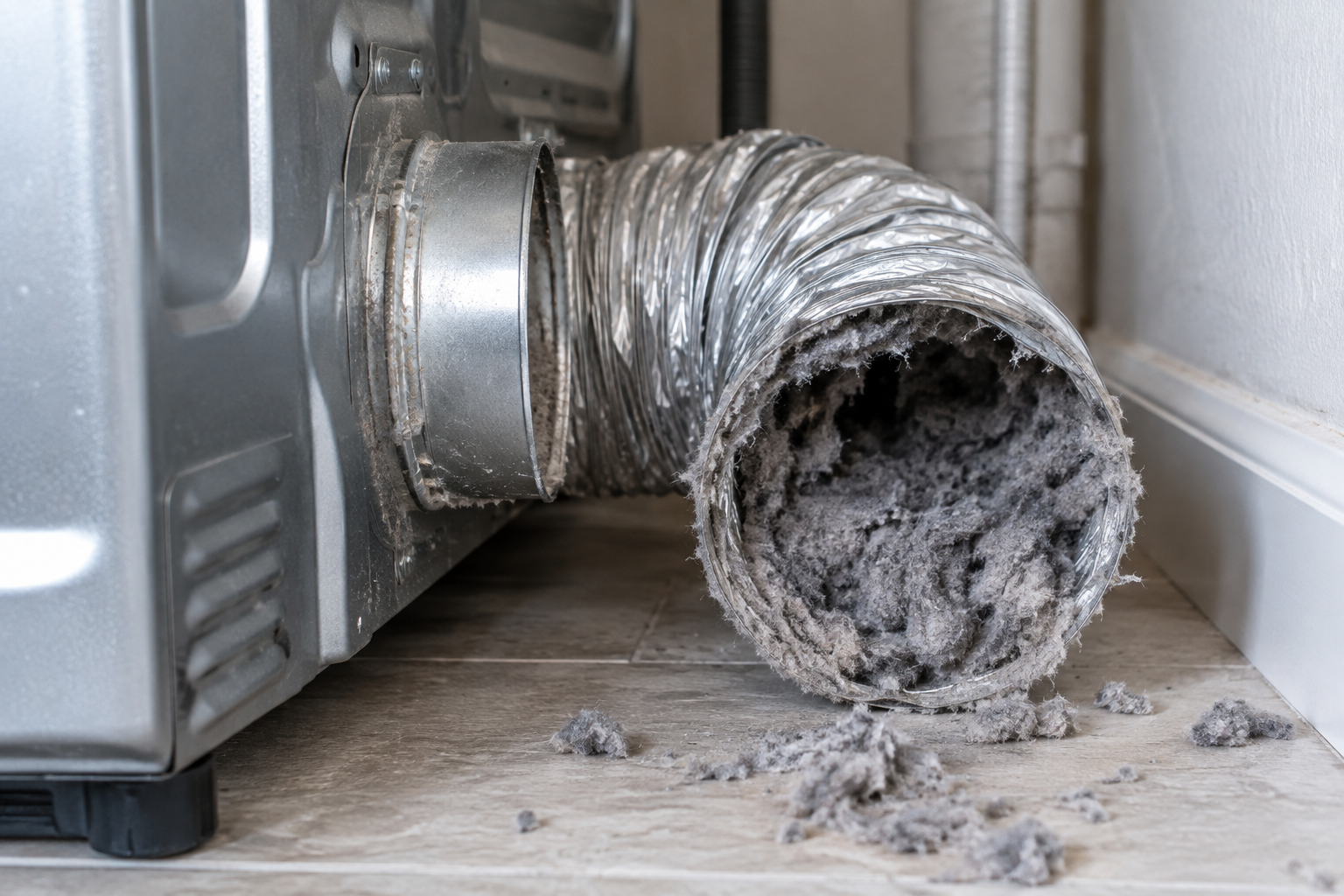
In New York City apartments and residential properties, dryer vents are rarely a straight shot to the outside. They often feature multiple 90-degree elbows to navigate around structural beams, plumbing, and electrical lines. Every turn in the ductwork creates a point of resistance where lint can settle. Over months of use, these small deposits layer upon one another, narrowing the diameter of the pipe. As the diameter decreases, the velocity of the air drops, causing even more lint to fall out of the airflow and settle, creating a compounding cycle of blockage.
How Restricted Airflow Becomes a Fire Hazard
According to the U.S. Fire Administration, the leading cause of clothes dryer fires is a failure to clean the equipment. The physics of the hazard are straightforward. A dryer requires a consistent volume of air to carry heat away from the heating element or gas burner. When lint buildup restricts this airflow, the heat cannot escape the drum effectively.
Dryer vent problem? Talk to a technician today.
This causes the internal temperature of the appliance to rise above its engineered safety limits. While modern dryers have high-limit thermostats designed to shut the unit down, these components can fail after repeated stress. If the temperature rises high enough, the highly flammable lint accumulated near the heating element can ignite. Once a fire starts inside the machine, the dryer’s own fan can act as a bellows, pushing flames into the lint-lined ductwork, which acts as a fuse traveling through the walls of the building. We see the same pattern on the jobs we run in Brooklyn. We see the same pattern on the jobs we run in Manhattan. For related background, read Determining Proper Dryer Vent Cleaning Frequency for NYC Apartments.
Common Dryer Fire Causes in NYC Buildings
In our 25+ years of experience at DVC Experts Inc., we have identified specific configurations that increase the risk for NYC residents and commercial operators:
- Long Vertical Runs: In many Manhattan high-rises, dryers vent into a central vertical shaft. If the booster fan serving these units fails or the duct is clogged, the dryer must work twice as hard to push air upward against gravity.
- Crushed Transition Ducts: The flexible foil or plastic hose behind the dryer is often crushed when the machine is pushed too close to the wall. This creates an immediate bottleneck for lint accumulation.
- Screen Obstructions: Exterior vent hoods in Brooklyn and Queens are often fitted with fine mesh screens to keep out pests. However, these screens quickly clog with wet lint, completely sealing the vent.
- Synthetic Fabric Loads: Modern clothing often contains high percentages of polyester and spandex. These synthetic fibers have a lower melting point than cotton and can contribute to a faster-spreading fire if ignition occurs.
A Checklist for Property Managers and Homeowners
To ensure your system is operating safely, monitor these specific indicators of lint-related stress:
- Dry Time: Any load that takes longer than one cycle to dry indicates an airflow issue.
- External Heat: The top of the dryer or the laundry room walls should not feel hot to the touch during operation.
- Flap Activity: Check the exterior wall cap while the dryer is running. If the louvers are not opening fully, air is not reaching the exit.
- Odors: A musty smell or the scent of scorched fabric requires an immediate shutdown of the appliance.
- Debris: Visible lint accumulation on the ground beneath the exterior vent indicates a bypass in the filtration system.
Professional Mitigation and Maintenance
Managing a property in the NYC area involves balancing numerous maintenance needs, but dryer exhaust systems are often overlooked because they are hidden behind walls. For property managers overseeing large portfolios or laundromat owners, a systematic approach to cleaning is a requirement for both safety and operational efficiency.
DVC Experts Inc. provides comprehensive cleaning and inspection services for residential and commercial clients across Brooklyn, Queens, Manhattan, Long Island, and the wider NYC area. With over 25 years of experience, we understand the specific architectural challenges of local buildings and the rigorous demands of high-volume laundry facilities.
If you have noticed declining performance or if it has been more than a year since your last professional inspection, contact DVC Experts Inc. at 1 718-305-7888 or visit our office at 509 Dahill Rd, Brooklyn, NY 11218. Ensuring your vents are clear is a practical step toward protecting your property and residents from preventable hazards. Call DVC Experts at 1 718-305-7888 or request a quote and we will take a look.
Dryer vent problem? Talk to a technician today.
Related articles
- Why a Dryer Smells Burnt or Musty
- Dryer Vent Cleaning for NYC New Parents
- Dryer Vent vs. Air Duct Cleaning: Understanding the Difference
Need help at home? See our residential dryer vent cleaning.