
Comparison
DIY vs. Professional Dryer Vent Cleaning: Knowing When to Call for Help
September 26, 2026
You are standing in a hardware store aisle in Brooklyn, looking at a plastic-wrapped vent brush kit that promises to save you money. Back at your apartment, the dryer is taking two cycles to finish a load of towels, and you know the vent hasn't been touched in years. The kit seems simple enough: attach it to a drill and push it through the wall. But as you look at the instructions, you realize you aren't sure where your vent actually leads—is it the roof, the side of the building, or a shared stack?
Is a retail brush kit sufficient for the complex ductwork found in NYC brownstones? Can a homeowner safely clear a vertical vent that stretches three stories? What are the actual risks of attempting this task without industrial vacuum equipment?
While basic surface cleaning is a routine chore for any homeowner, deep-system dryer vent cleaning in multi-story or high-density buildings usually requires industrial-grade tools to avoid compaction and duct damage.
The Limitations of Retail Vent Brush Kits
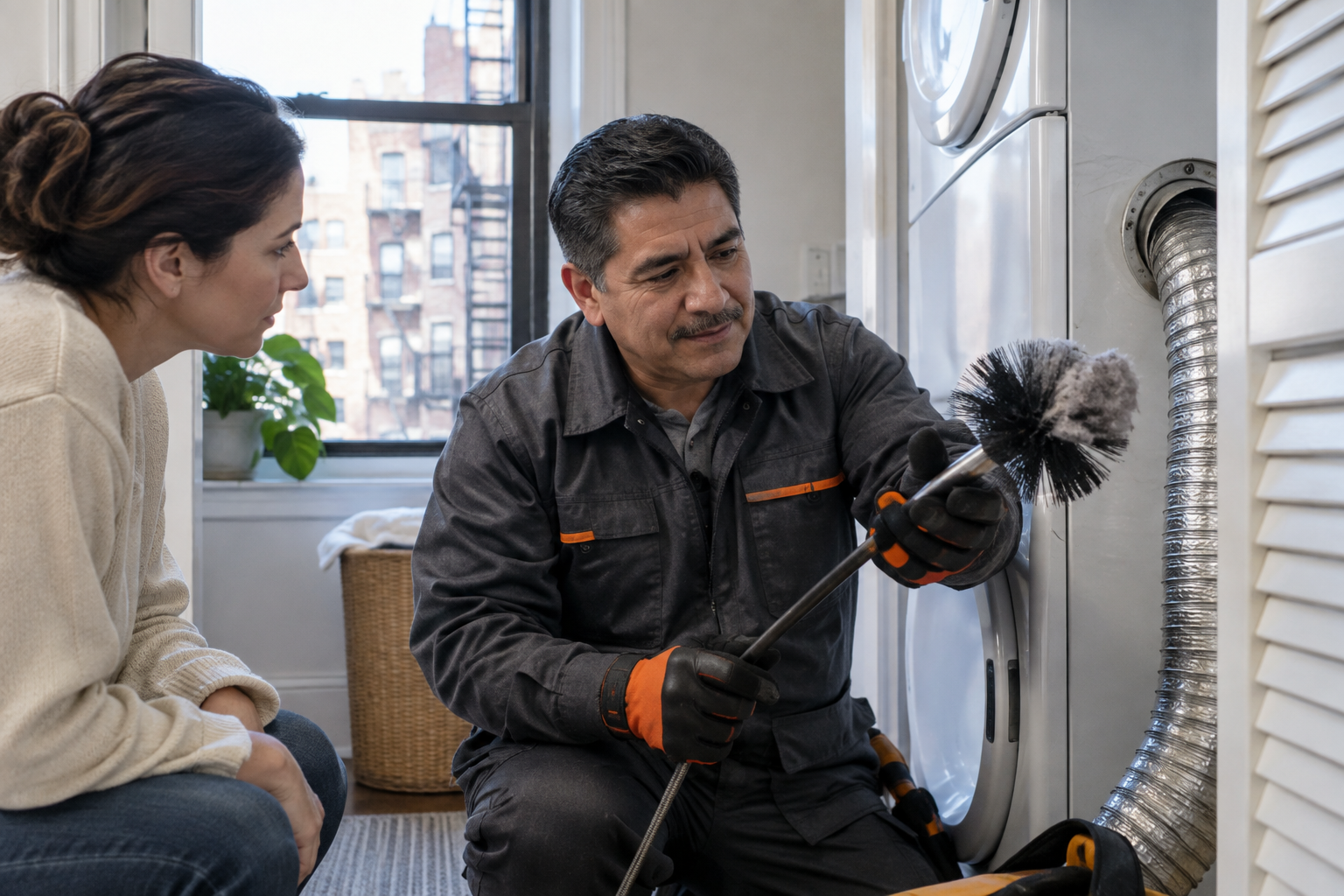
Most homeowners start their research by looking at a standard vent brush kit available at local big-box stores. These kits typically consist of a nylon brush head and several flexible rods that screw together. For a short, straight run—perhaps a five-foot exhaust pipe leading directly through a basement wall—these tools can remove loose lint. However, many residential dryer setups in New York City are far from simple.
In older homes across Brooklyn and Queens, vents often take multiple 90-degree turns to navigate around structural beams or plumbing. When a homeowner pushes a retail rod into these bends, the rod can snap or the brush head can become detached. If a brush gets stuck halfway through a wall, the resulting blockage is much harder to fix than the original lint buildup. Furthermore, these brushes often just push the lint further back, creating a dense "plug" rather than actually extracting the debris from the system.
Why NYC Ductwork Often Requires Professional Grade Tools
Professional technicians use high-pressure compressed air tools and industrial vacuums that retail kits cannot replicate. In high-rise environments in Manhattan, vents may run for 20 or 30 feet before reaching an exterior exhaust point. Gravity works against you in these vertical runs; lint that is loosened but not fully removed will simply fall back down and settle in the transition hose behind the dryer.
Dryer vent problem? Talk to a technician today.
Professionals also use specialized cameras to inspect the interior of the duct. This allows them to identify disconnected pipes or crushed sections of foil venting that a brush would simply skip over. Understanding what determines dryer vent cleaning cost is often a matter of evaluating the length of the run and the accessibility of the exterior port, factors that also dictate whether a DIY approach is even feasible.
The Safety Risks of Improper Cleaning
According to the U.S. Fire Administration, failure to clean the dryer vent is the leading cause of clothes dryer fires. While a DIY attempt is better than doing nothing at all, an incomplete cleaning can provide a false sense of security. If a homeowner cleans the first few feet of the vent but leaves a massive accumulation deeper in the wall, the dryer will continue to overheat.
In commercial settings like laundromats or gyms, the volume of lint produced makes DIY methods almost entirely ineffective. Heavy-duty usage requires the high-volume extraction that only professional equipment provides. Beyond fire risks, an improperly cleaned vent can lead to carbon monoxide backup in gas dryers if the exhaust cannot escape the building. Professional services include airflow testing to ensure the system is actually venting at the manufacturer's required velocity before the job is considered complete.
Decision Framework: DIY or Professional?
Before you decide to tackle this project yourself, evaluate your home's specific configuration using the following criteria:
- Length of Run: If your vent is longer than 10 feet, DIY tools are unlikely to reach the exit point effectively.
- Number of Elbows: Every 90-degree turn in the pipe increases the risk of a brush getting stuck or lint compacting in the corner.
- Exit Location: If your vent exits on a roof or a high exterior wall that requires a long ladder, it is safer to hire a professional.
- Dryer Performance: If the dryer cabinet is hot to the touch or there is a "musty" smell, the blockage may be severe enough to require mechanical extraction.
- Duct Material: If you have old, flexible plastic or foil venting, these materials are easily punctured by DIY brushes and should be replaced with rigid metal by a professional.
DVC Experts Inc. brings 25+ years of experience to every job, ensuring your venting system is clear and compliant with safety standards. We serve residential and commercial clients throughout Brooklyn, Queens, Manhattan, and Long Island.
If your dryer is struggling to keep up or you are concerned about the age of your venting system, contact the team at DVC Experts Inc. for a thorough inspection. You can reach us at 1 718-305-7888 or visit our contact page to schedule a service visit at your convenience.
Dryer vent problem? Talk to a technician today.
Related articles
- Dryer Vent vs. Air Duct Cleaning: Understanding the Difference
- Dryer Vent Cleaning for NYC Building Crews
- Dryer Vent Cleaning for NYC New Parents
Need help at home? See our residential dryer vent cleaning.