
Advice
Dryer Vent Cleaning for NYC Building Crews
October 10, 2026
You are a building superintendent or part of a maintenance crew in a mid-sized Manhattan residential building. One of your tenants complains that the laundry room is unusually humid, while another mentions their unit's dryer is hot to the touch. You check the lint traps, but the problem persists deep within the building's infrastructure. In the dense environment of New York City, these localized issues often point to a systemic failure in the exhaust path that requires more than a simple hand-tool fix.
Should your staff attempt to clear internal risers themselves? How do you distinguish between a mechanical dryer failure and a vent obstruction? What is the most efficient way to coordinate access for a full-building service?
Effective building maintenance in New York City requires a clear distinction between daily lint trap clearing and professional dryer vent cleaning NYC to prevent mechanical strain and fire hazards.
The Limits of On-Site Maintenance Staff
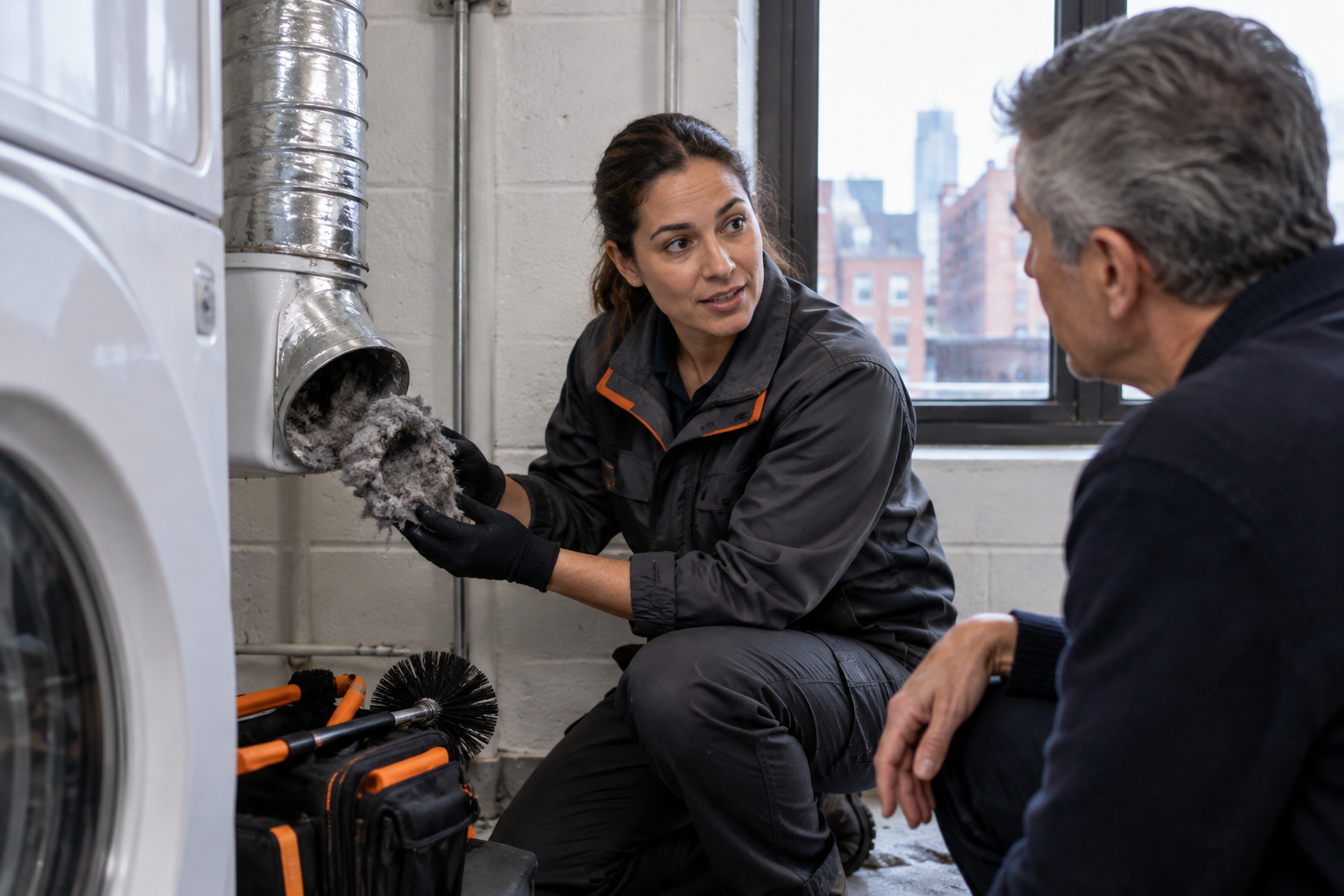
Building staff are excellent at high-frequency tasks, such as clearing lint screens and checking for immediate obstructions at the dryer connection. However, most NYC multi-family buildings utilize complex duct runs that travel through fire-rated walls, ceiling joists, and common shafts. A standard shop vacuum or short brush typically cannot reach the vertical climbs found in a Manhattan high-rise or the extended horizontal runs in a large Brooklyn warehouse conversion.
For property managers overseeing a commercial laundry facility or a managed residential portfolio, relying solely on in-house staff for deep cleaning can lead to incomplete results. Professional equipment, such as high-pressure compressed air tools and industrial-grade rotobrushes, is necessary to navigate the 90-degree elbows common in NYC architecture. Without these, lint continues to accumulate in dead zones, creating a fuel source for potential fires.
Identifying Systemic Obstructions vs. Appliance Failure
Maintenance crews often spend hours troubleshooting a dryer that won't heat, only to find the appliance is functioning perfectly but has tripped its internal thermal fuse due to backpressure. The U.S. Fire Administration reports that failure to clean is the leading factor contributing to clothes dryer fires in residential buildings. When a system is backed up, heat cannot escape, which often explains why a dryer smells burnt or musty during a heavy cycle.
Dryer vent problem? Talk to a technician today.
Superintendents should look for these three specific red flags across multiple units:
- Consistent humidity or condensation on windows in the laundry area.
- Dryer cabinets that feel excessively hot to the touch after 20 minutes of operation.
- Visible lint accumulation on the exterior masonry or around the outdoor louvers.
If these signs appear, it is rarely an isolated appliance issue. It is typically a sign that the entire stack requires a professional dryer vent cleaning NYC service to restore the necessary CFM (Cubic Feet per Minute) of airflow.
Coordinating Large-Scale Building Cleanings
For those managing properties in Queens or Long Island, scheduling is the greatest hurdle. Maintenance crews are often tasked with escorting contractors and providing access to individual apartments. A structured approach reduces the time spent per unit and ensures no segment of the ductwork is missed.
We recommend a "top-down" or "stack-by-stack" strategy. By cleaning all units sharing a common vertical riser on the same day, you ensure that dislodged lint does not settle into a lower unit’s connection point. This systematic method is the only way to guarantee the integrity of the entire exhaust system from the laundry room to the roof termination.
Maintenance Crew Checklist for Dryer Safety
Use this checklist to determine if it is time to transition from routine maintenance to a professional intervention:
- Check the exterior vent hoods: Are the flaps moving freely when the dryer is on?
- Inspect the transition ducts: Are the flexible hoses behind the dryers crushed or kinked?
- Monitor drying times: Does a standard load take longer than 50 minutes to dry?
- Document the last service: Has it been more than 12 months since the main trunk lines were professionally cleared?
- Inspect the floor: Is there an unusual amount of lint accumulating behind the machines despite regular cleaning?
DVC Experts Inc. brings 25+ years of experience to every job, helping NYC building crews maintain safe and efficient laundry systems. To schedule an inspection for your building or to request a service proposal, call 1 718-305-7888 or visit our contact page.
Dryer vent problem? Talk to a technician today.
Related articles
- Dryer Vent Cleaning for NYC New Parents
- Dryer Vent Safety for NYC Vacation Rentals
- Dryer Vent vs. Air Duct Cleaning: Understanding the Difference
Managing a building or laundromat? See our commercial dryer vent cleaning.