
How it works
Verifying Performance: How Airflow is Tested After Dryer Vent Cleaning
October 7, 2026
You finish a laundry cycle in your Brooklyn brownstone only to find the clothes are still damp. After a professional cleaning, you expect the machine to perform like new, but how do you know the technician actually cleared the entire line? In complex New York City buildings, a visual inspection of the vent exit is rarely enough to prove the job was done correctly.
Is the dryer exhausting at the manufacturer's required velocity? Did the cleaning resolve a hidden blockage deep within a ceiling cavity? How can a property manager verify the safety of a high-rise exhaust system?
Professional airflow testing provides the only objective data needed to confirm a dryer vent system is clear, safe, and operating at peak efficiency.
The Role of the Anemometer in Vent Verification
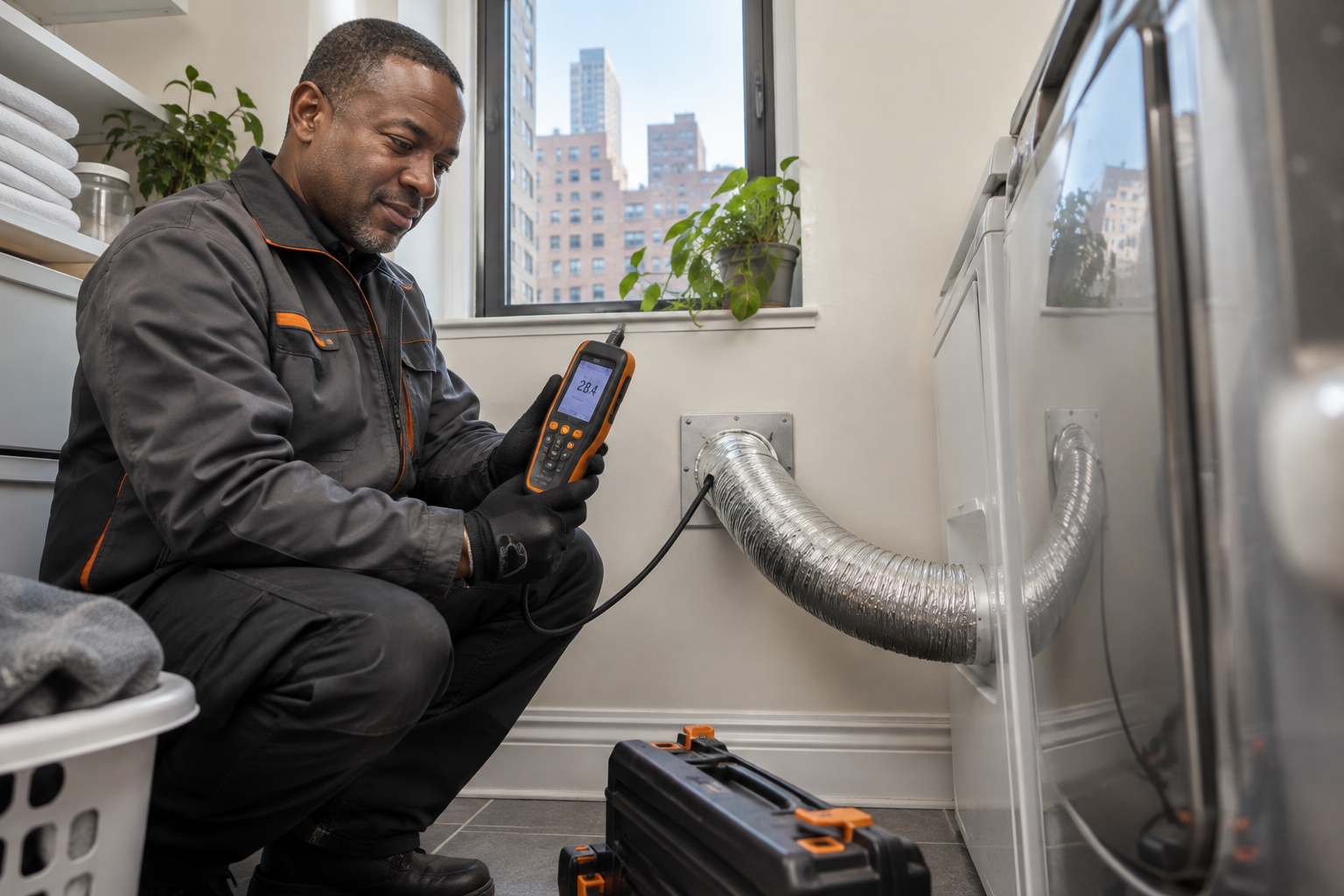
The primary tool for an airflow test dryer vent professionals use is the digital anemometer. This device measures the velocity of the air as it exits the vent terminal. In a typical residential setting, air should move at a specific speed—usually measured in feet per minute (FPM) or miles per hour—to ensure lint does not settle inside the ductwork.
Before the cleaning begins, a baseline reading is taken at the exterior exhaust. In many Manhattan apartments, this vent might be located on a high-rise facade or a rooftop. Once the cleaning is complete, a second reading is taken. A significant increase in FPM confirms that the obstructions have been removed. If the airflow remains low despite a cleaning, it indicates a structural issue, such as a crushed transition duct or a disconnected pipe behind a wall.
Static Pressure and System Backpressure
Airflow isn't just about speed; it is also about the resistance the dryer motor faces. High backpressure forces the dryer to run hotter and longer, which increases the risk of component failure. Technicians often use a magnehelic gauge or a digital manometer to measure the static pressure within the duct.
Dryer vent problem? Talk to a technician today.
When we perform a commercial cleaning for a laundromat or a multi-family building, these pressure readings are vital. They help identify if the ductwork design itself is flawed, such as having too many elbows or an excessive total length. While dryer vent vs. air duct cleaning involve different systems and goals, both require verifying that the air is moving as intended to protect the building's mechanical integrity.
Why Visual Inspections Aren't Enough in NYC
In suburban homes, a vent might run straight through a single wall. In Brooklyn and Queens, however, vents often travel through floor joists, behind cabinetry, or up through several stories to reach a roof. You cannot see inside these turns with a flashlight.
To verify vent cleaning in these environments, specialized diagnostic tools are necessary. According to the U.S. Fire Administration, failure to clean the dryer vent is the leading cause of dryer fires. Testing ensures that the "hidden" parts of the vent—the sections you cannot see—are no longer harboring the combustible lint that leads to these hazards. A successful test proves that the entire path, from the back of the dryer to the outdoor hood, is unobstructed.
Post-Cleaning Verification Checklist
When a service visit is complete, property owners should look for these specific indicators that the airflow has been restored:
- Direct Velocity Reading: The technician should be able to provide the FPM reading before and after the service.
- External Vent Flap Movement: When the dryer is running, the exterior vent weighted flapper should open fully and consistently.
- Dryer Internal Heat Regulation: The dryer should no longer feel excessively hot to the touch on its exterior cabinet.
- Consistent Cycle Times: A standard load of towels should dry in a single cycle, typically 45 to 55 minutes, depending on the machine model.
Verifying these metrics ensures that the service provided a tangible improvement to your appliance's performance and your home's safety.
DVC Experts Inc. brings 25+ years of experience to every job, ensuring your exhaust systems meet safety standards across the NYC area. For professional testing and cleaning in residential or commercial properties, call 1 718-305-7888 or contact our team to schedule an inspection.
Dryer vent problem? Talk to a technician today.
Related articles
- Dryer Vent Access in NYC Tight Spaces
- Roof Vent vs. Wall Vent: Why Termination Point Matters for Cleaning
- Warning Signs of a Clogged Dryer Vent in NYC Properties
Need help at home? See our residential dryer vent cleaning.