
Advice
Dryer Vent Access in NYC Tight Spaces
October 12, 2026
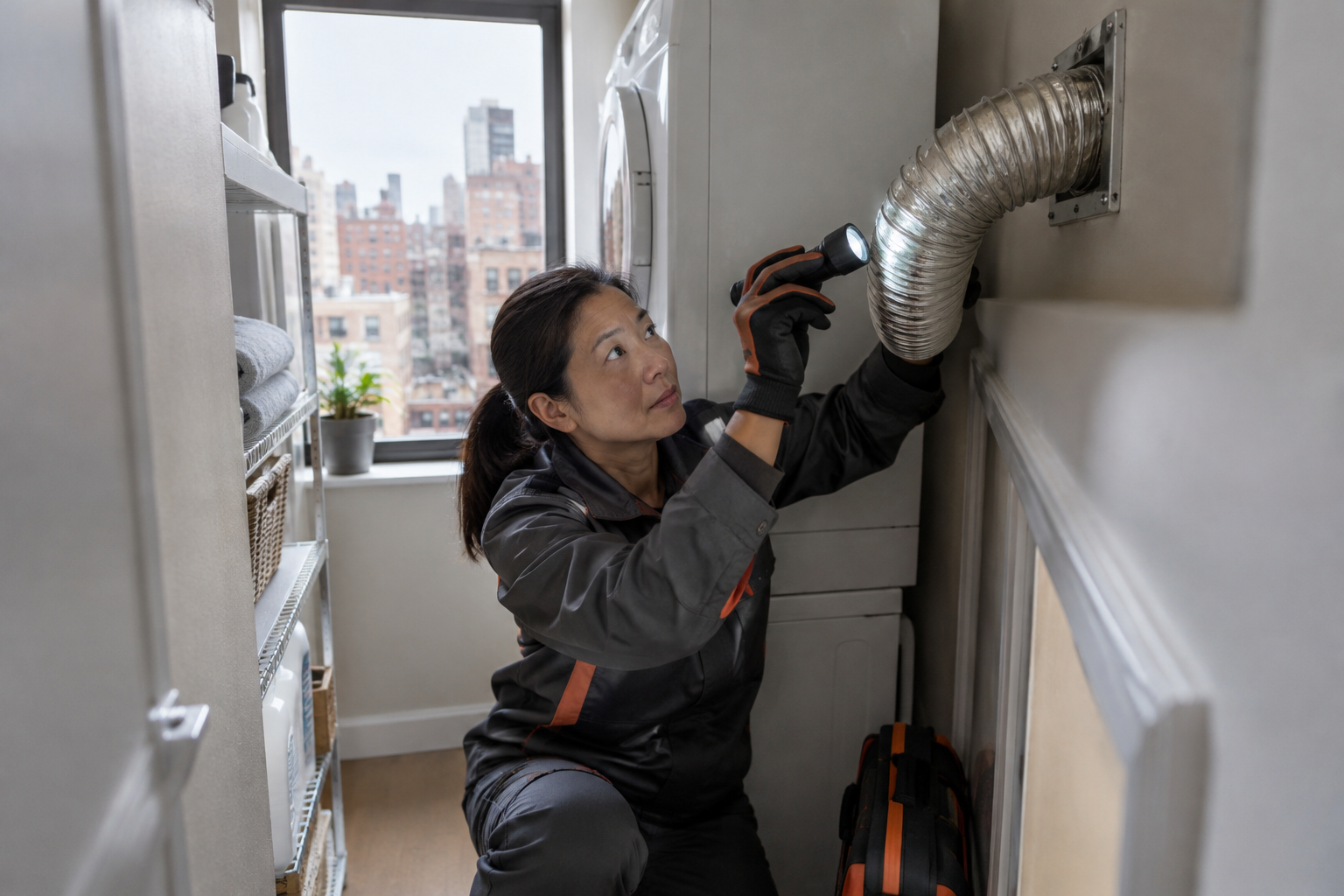
You are standing in your Brooklyn galley kitchen or a compact Manhattan utility closet, staring at a dryer that has been shoved into a space with less than two inches of clearance on either side. The machine is hot to the touch, and you know the vent hasn't been inspected in years, but the thought of pulling the unit out without damaging the floor or the gas line feels impossible. In many New York City residences, the dryer wasn't just installed; it was effectively entombed.
How do you maintain a system you cannot physically reach? What happens when the lint buildup occurs in a segment of pipe hidden behind custom cabinetry or permanent millwork? Is it possible to perform a thorough cleaning without a full demolition of your laundry nook?
Reliable dryer vent maintenance in NYC requires specialized tools and strategic access points to overcome the physical constraints of high-density urban living.
The Problem with Zero-Clearance Installations
In a typical suburban home, a dryer sits in a spacious basement or mudroom with ample space to pull the machine away from the wall. In NYC, space is the ultimate premium. Developers often squeeze laundry units into closets where the machine occupies 98% of the available footprint. This creates a "blind hookup" scenario. When the dryer is pushed back into place, the flexible transition duct—the pipe connecting the machine to the wall—often kinks or crushes against the rear partition.
This physical restriction is a primary driver of lint accumulation. Even if the main vertical stack is clear, a crushed transition duct at the point of access will restrict airflow and trap debris. For residents in Manhattan, where square footage is most limited, these tight installs are the rule rather than the exception. Without proper clearance, the heat cannot dissipate, and the dryer’s internal sensors may fail prematurely. Overcoming these tight spaces often involves using low-profile "periscope" connectors or recessed dryer vent boxes that allow the machine to sit flush against the wall without pinching the pipe.
Strategic Access and Clean-Out Ports
When a dryer vent runs through a soffit or behind a bathroom wall, you cannot simply pull the machine out to reach the blockage. This is particularly common in residential renovations where laundry was added to an older floor plan. If the duct run exceeds several feet and includes multiple turns, a single access point at the back of the dryer is insufficient for a complete cleaning.
Dryer vent problem? Talk to a technician today.
Professional technicians often look for or install clean-out ports. These are small, sealed openings in the ductwork located in accessible areas, such as the back of a closet or under a sink, allowing brushes and high-pressure air tools to reach deep into the system. If your home has a complex layout, you may find that managing stackable dryer vents in NYC requires extra attention to these intermediate access points to ensure the entire line is cleared of combustible lint. Without these ports, a technician might be forced to navigate 20 feet of pipe through a single 4-inch opening, which significantly reduces the effectiveness of the cleaning tools.
The Risks of Hidden Ductwork Failures
In many Brooklyn brownstones and townhomes, dryer vents were retrofitted through existing chimneys or decorative voids. Because these vents are hidden, a disconnection or a tear in the duct often goes unnoticed for months. If a vent pipe becomes detached behind a wall, the dryer will vent hot, moist, lint-filled air directly into the building's structure.
This leads to two major issues: a fire hazard and a moisture problem. The U.S. Fire Administration notes that failure to clean the dryer vent is the leading cause of clothes dryer fires. When that lint is trapped inside a wall cavity rather than a metal pipe, the risk increases. Furthermore, the moisture can lead to wood rot and mold growth in areas you cannot see. Regular airflow testing from the exterior termination point is the only way to verify that the air exiting the building matches the air leaving the dryer, confirming that the hidden ductwork is still intact.
Checklist for Evaluating Your Vent Access
If you are a property manager or homeowner, use this framework to determine if your vent system is maintainable:
- Visual Clearance: Can you see the connection point between the dryer and the wall without moving the machine? If not, you likely have a blind installation.
- Machine Mobility: Is the dryer on a pedestal or a stable floor that allows it to be slid forward, or is it wedged tightly under a countertop?
- Termination Accessibility: Can the exterior vent cap be reached via a standard ladder or a window, or is it located on a high-rise facade requiring specialized equipment?
- Wall Temperature: Does the wall or cabinet surrounding the dryer feel excessively hot during a cycle? This often indicates heat is being trapped in a cramped space.
- Duct Material: In tight spaces, is the connection made of fire-rated rigid metal, or is there a dangerous plastic "slinky" hose that is easily crushed?
Addressing these access issues before a total blockage occurs is essential for long-term safety and appliance efficiency. DVC Experts Inc. brings 25+ years of experience to every commercial and residential job, navigating the unique architectural hurdles found throughout Queens and the five boroughs.
If your dryer is located in a difficult-to-reach space or if you haven't had your airflow tested recently, contact the professionals to ensure your system is venting safely. Reach DVC Experts Inc. at 1 718-305-7888 or visit our contact page to schedule an inspection at 509 Dahill Rd, Brooklyn, NY 11218.
Dryer vent problem? Talk to a technician today.
Related articles
- Verifying Performance: How Airflow is Tested After Dryer Vent Cleaning
- Warning Signs of a Clogged Dryer Vent in NYC Properties
- Dryer Vent Cleaning for NYC Building Crews
Need help at home? See our residential dryer vent cleaning.