
Commercial
Establishing a Professional Laundromat Dryer Vent Maintenance Schedule
September 17, 2026
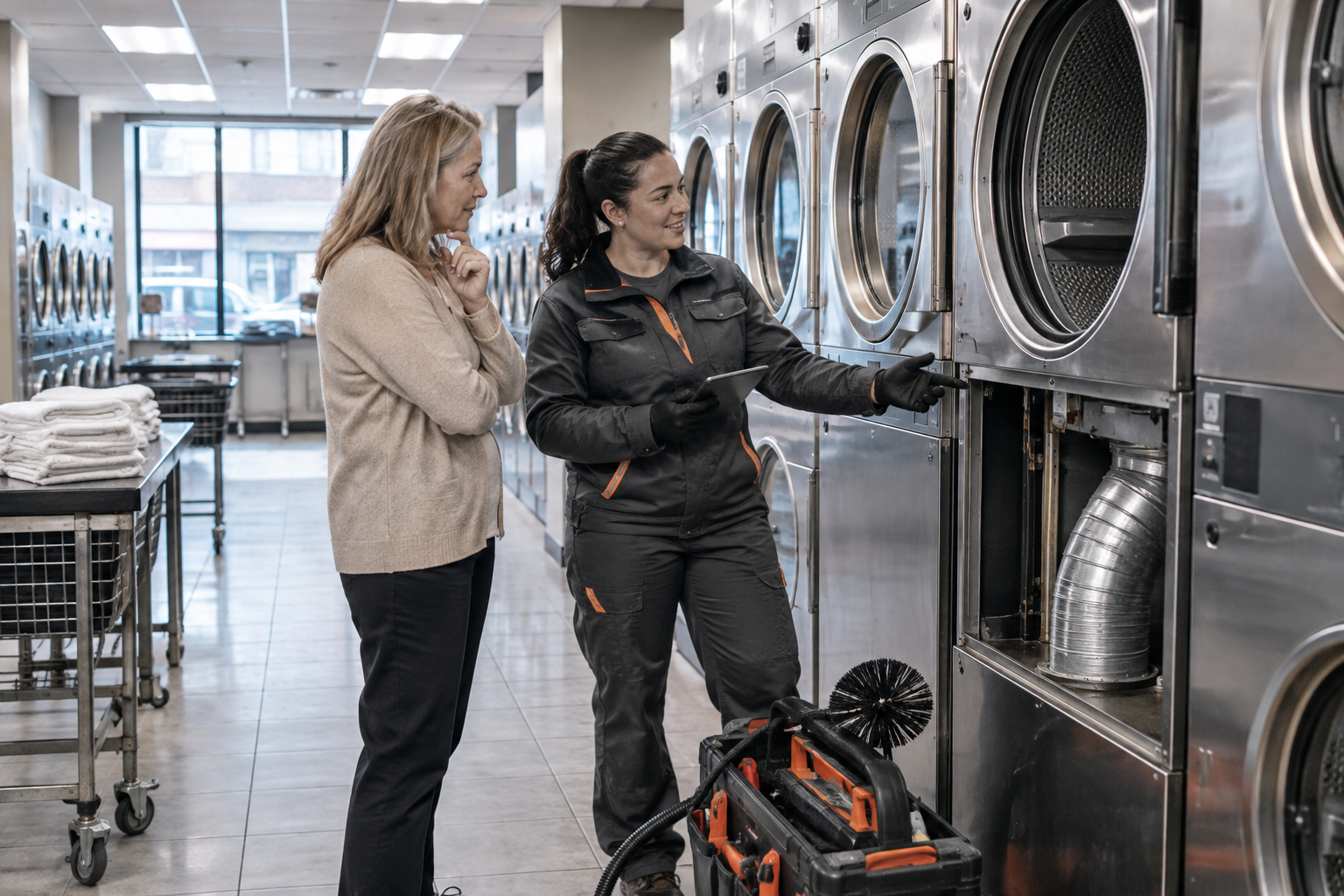
A busy Saturday afternoon in a Brooklyn laundromat often means every machine is running at maximum capacity. When a customer complains that their heavy load of towels is still damp after two full cycles, it is rarely a problem with the heating element. More often, it is the result of thousands of previous loads depositing fine layers of lint deep within the shared ductwork. In the high-volume environment of a New York City wash-and-fold business, the stakes for maintenance are significantly higher than in a typical household.
How often should a high-volume facility inspect its exhaust system? What are the specific indicators that a schedule needs to be accelerated? A rigorous laundromat dryer vent maintenance schedule is the primary defense against operational downtime and the heightened risk of commercial structure fires.
The Impact of High-Volume Lint Accumulation
Commercial dryers process more laundry in a single day than a residential machine handles in a month. While these machines feature heavy-duty lint screens, they are not absolute filters. The fine particulate matter that bypasses the screen enters the ducting, where it adheres to the walls, particularly at bends and transition points. Over time, this buildup creates backpressure.
This backpressure forces the dryer to work harder, increasing energy consumption and causing internal components to overheat. For businesses operating in high-rent districts like /manhattan, managing these utility costs is vital for maintaining profit margins. When airflow is restricted, the moisture removed from the clothes cannot escape, leading to the humid, stifling air often felt in poorly maintained facilities. Unlike the strategies discussed in our guide on /blog/multi-family-dryer-vent-cleaning-property-managers-2026-09-16, a laundromat requires a much more aggressive intervention frequency due to the continuous nature of the machine usage.
Fire Safety and Regulatory Compliance
According to the U.S. Fire Administration, failure to clean the dryer vent is the leading cause of clothes dryer fires. In a commercial setting, the volume of lint available as fuel is significantly higher. If a fire starts within a machine, the lint-lined ductwork acts as a fuse, potentially carrying the flames through the building structure.
Dryer vent problem? Talk to a technician today.
For owners of /commercial facilities, maintaining a documented cleaning log is not just about safety; it is often a requirement for insurance compliance. Fire inspectors in /brooklyn and other boroughs look for evidence of proactive maintenance. A scheduled cleaning ensures that the heavy-duty exhaust fans and booster fans common in laundromats are clear of obstructions that could trigger a thermal cutoff or a fire. Most of this work falls under our residential dryer vent cleaning service.
Factors Determining Your Maintenance Frequency
The standard recommendation for a residential home is an annual cleaning, but for a laundromat, this is insufficient. Several variables dictate how often your vents require professional attention:
- Machine Count: A facility with thirty dryers generates thirty times the lint of a single unit, often into a shared manifold system that can clog rapidly.
- Duct Length: Longer runs with multiple elbows provide more surface area for lint to settle. If your exhaust exits through a roof several stories up, the frequency must increase.
- Customer Demands: Facilities that handle high volumes of rugs, comforters, or industrial workwear will see faster accumulation than those strictly handling apparel.
- Ambient Environment: Laundromats in dusty urban areas or those with poor makeup air systems may see lint trap bypass more frequently.
Most high-traffic laundromats in /queens find that a quarterly or bi-annual professional cleaning is necessary to keep machines running at peak efficiency and to prevent premature equipment failure.
Commercial Maintenance Checklist
To keep your facility running smoothly between professional cleanings, staff should follow a strict daily and weekly protocol:
- Shift-Based Screen Cleaning: Lint screens must be cleaned after every single load, without exception.
- Visual External Inspections: Check the exterior vent hoods daily to ensure flaps are moving freely and no lint is accumulating on the building face.
- Dryer Cabinet Vacuuming: Once a month, the interior cabinets of the dryers should be vacuumed to remove lint that has settled around the motor and gas burners.
- Temperature Monitoring: If a specific bank of dryers is consistently requiring longer run times, it is an immediate signal to inspect the main trunk line.
Establishing a relationship with a dedicated service provider ensures these technical checks are handled correctly. DVC Experts Inc. brings 25+ years of experience to every job site, helping business owners maintain their equipment across the NYC area.
To schedule a professional inspection or to establish a recurring maintenance plan for your facility, call DVC Experts Inc. at 1 718-305-7888 or visit our /contact page to request a consultation. Our team is located at 509 Dahill Rd, Brooklyn, NY 11218 and serves the entire metropolitan region.
Dryer vent problem? Talk to a technician today.
Related articles
- Commercial Dryer Vent Cleaning for NYC Salons and Gyms
- Multi-Family Dryer Vent Maintenance for NYC Property Managers
- High-Rise Dryer Venting Challenges and Maintenance for NYC Towers
Managing a building or laundromat? See our commercial dryer vent cleaning.