
Commercial
Multi-Family Dryer Vent Maintenance for NYC Property Managers
September 16, 2026
Imagine a Tuesday morning in a 50-unit Brooklyn co-op. A resident on the third floor notices their laundry is still damp after two cycles, while the building manager receives a complaint about excessive humidity in the hallways. By the afternoon, a different tenant reports a burning smell coming from the laundry room. These are not isolated incidents; they are the early warning signs of a systemic maintenance failure in a building’s ventilation infrastructure.
How do property managers balance individual tenant needs with large-scale fire safety requirements? When does building-wide maintenance become more cost-effective than reactive repairs? What are the specific challenges of maintaining laundry systems in high-density New York City environments?
Proactive multi-family dryer vent cleaning is a critical operational safeguard that protects building assets, reduces liability, and ensures the safety of all residents.
The Risks of Deferred Maintenance in High-Rises
In a single-family home, a clogged vent is a localized problem. In a multi-family setting, particularly in dense areas like Manhattan, a single dryer fire can displace dozens of families and cause millions of dollars in property damage. According to the U.S. Fire Administration, failure to clean dryer vents is the leading cause of clothes dryer fires. In high-rise buildings, vent runs are often long, complex, and integrated into common shafts. When lint accumulates in these shared vertical paths, it creates a continuous fuel source that can allow a fire to spread rapidly between floors.
Beyond the fire risk, deferred maintenance leads to mechanical failure. When air cannot escape, heat builds up within the dryer unit, often causing thermal fuses to blow or heating elements to burn out prematurely. For managers overseeing commercial laundry rooms or buildings with in-unit machines, this results in constant service calls and disgruntled tenants.
Economies of Scale and Compliance
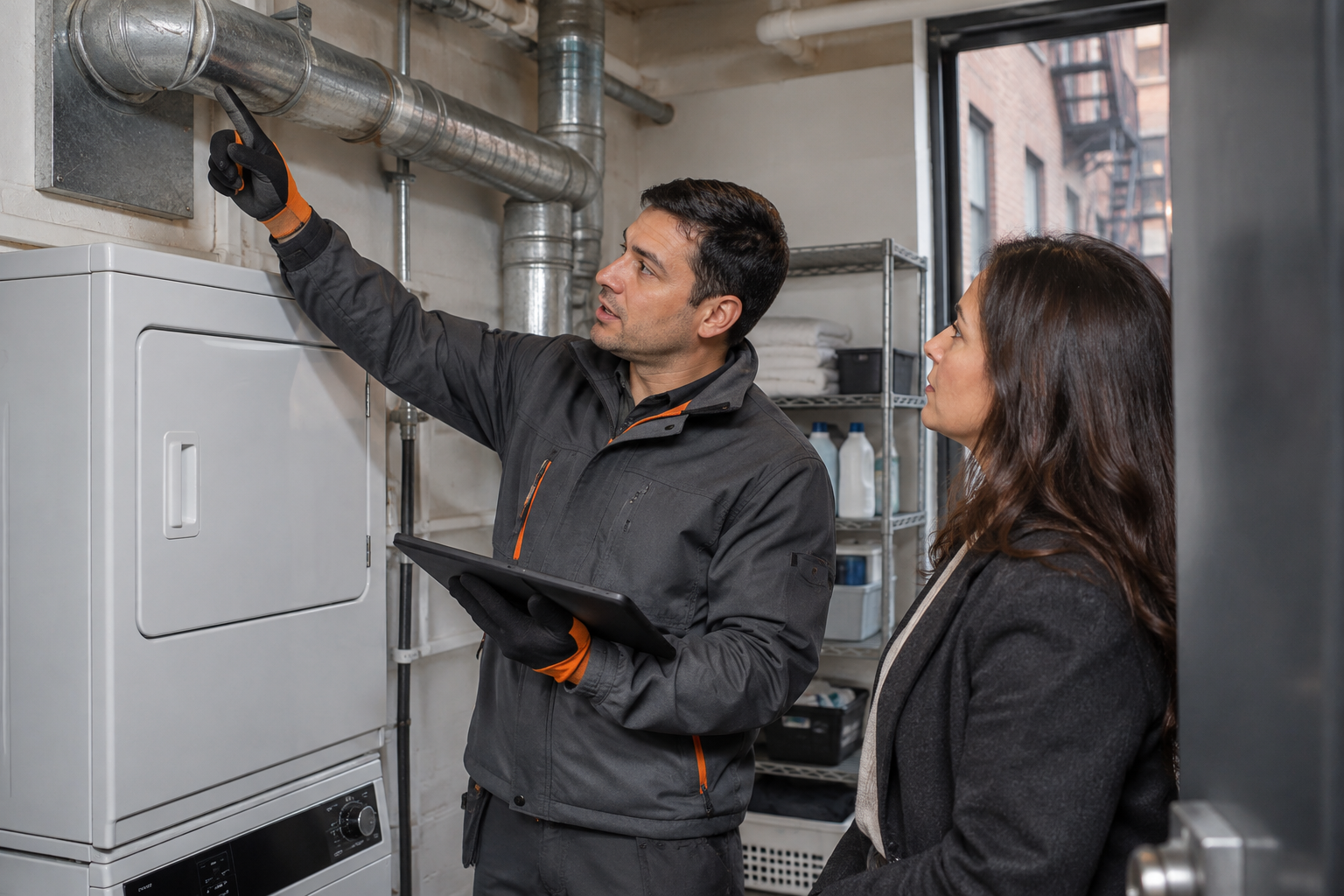
Property managers and HOA boards often hesitate to schedule building-wide cleaning due to the logistics of accessing multiple units. However, scheduling a comprehensive service for the entire building is significantly more efficient than addressing units one by one. This approach allows for a total system audit, ensuring that no single unit is compromising the airflow of the entire vertical stack.
Dryer vent problem? Talk to a technician today.
For those managing portfolios in Brooklyn, regular inspections help meet insurance requirements and local safety standards. A documented history of professional cleaning can be a vital asset during insurance renewals or building inspections. Managers should also consider dryer vent cleaning frequency for NYC apartments when planning their annual budgets, as high-occupancy buildings typically require more frequent intervention than suburban homes.
Technical Challenges of Multi-Family Ventilation
Multi-family buildings present unique architectural hurdles. Many NYC structures utilize booster fans to move air through long horizontal or vertical runs that exceed the dryer's internal fan capacity. If these booster fans fail or become clogged with lint, the entire system stalls.
Furthermore, the transition ducts behind the machines in cramped apartments are frequently crushed or kinked during tenant move-ins. Professional residential services for multi-family units involve not just cleaning the main stack, but also inspecting these individual connections. In areas like Queens, where older multi-family conversions are common, technicians often find outdated plastic foil venting that must be replaced with rigid metal to meet modern safety codes.
Manager’s Checklist for Building-Wide Cleaning
When coordinating a large-scale cleaning project, managers should use the following framework to ensure thoroughness:
- Access Coordination: Ensure all tenants are notified well in advance to provide access to in-unit dryers.
- External Termination Points: Verify that all exterior wall caps or roof vents are clear of bird nests and mechanical obstructions.
- Booster Fan Testing: Check that all inline booster fans are triggered correctly by airflow and are free of debris.
- Documentation: Request a detailed report of which units were serviced and any deficiencies found, such as torn transition ducts or improper venting materials.
- Airflow Measurement: Ensure the service includes pre- and post-cleaning airflow readings to verify the effectiveness of the work.
Long-Term Value and Safety
DVC Experts Inc. brings 25+ years of experience to the complex task of maintaining NYC’s multi-family housing stock. We understand the logistical needs of property managers and the technical requirements of large-scale ventilation systems. By addressing these systems holistically, managers can lower energy costs for tenants, extend the life of building appliances, and most importantly, mitigate the risk of a catastrophic fire.
To discuss a maintenance plan for your building or to request an inspection, contact DVC Experts Inc. at 1 718-305-7888 or visit our contact page to speak with a specialist today.
Dryer vent problem? Talk to a technician today.
Related articles
- Landlord Responsibilities for Dryer Vents in New York
- Dryer Venting in Condos and Co-ops: Determining Responsibility
- Dryer Vent Cleaning for NYC Building Crews
Managing a building or laundromat? See our commercial dryer vent cleaning.