
Commercial
High-Rise Dryer Venting Challenges and Maintenance for NYC Towers
September 24, 2026
A property manager in a glass-walled tower in Lower Manhattan notices a recurring complaint across multiple floors: laundry takes three cycles to dry, and hallways feel unusually humid. In a high-rise environment, these symptoms often point to a systemic failure in the vertical duct riser rather than a mechanical issue with individual appliances.
Does your building maintenance schedule account for the unique physics of vertical airflow? Are your booster fans functioning, or are they inadvertently creating lint traps? Can your current service provider reach the exterior terminations twenty stories up?
Managing high-rise dryer venting requires a specialized understanding of vertical static pressure, integrated booster systems, and the logistics of servicing densely packed residential units.
The Physics of Vertical Duct Risers
Unlike single-family homes where vents typically travel a short distance to an exterior wall, high-rise systems often rely on a complex network of internal ducts. In many NYC buildings, individual dryers feed into a primary vertical duct riser that carries exhaust to the roof. This design creates significant backpressure. According to the U.S. Fire Administration, lint is highly combustible, and its accumulation in these long vertical runs is a primary cause of dryer-related fires.
When lint builds up in a riser, it doesn't just affect one unit; it restricts the exit path for every dryer connected to that line. This is a common issue we address in commercial settings where heavy usage accelerates debris buildup. Gravity also plays a role, as heavy, wet lint often settles in the lower bends of the ductwork, requiring high-powered vacuum equipment to clear effectively.
The Role and Risk of Booster Fans
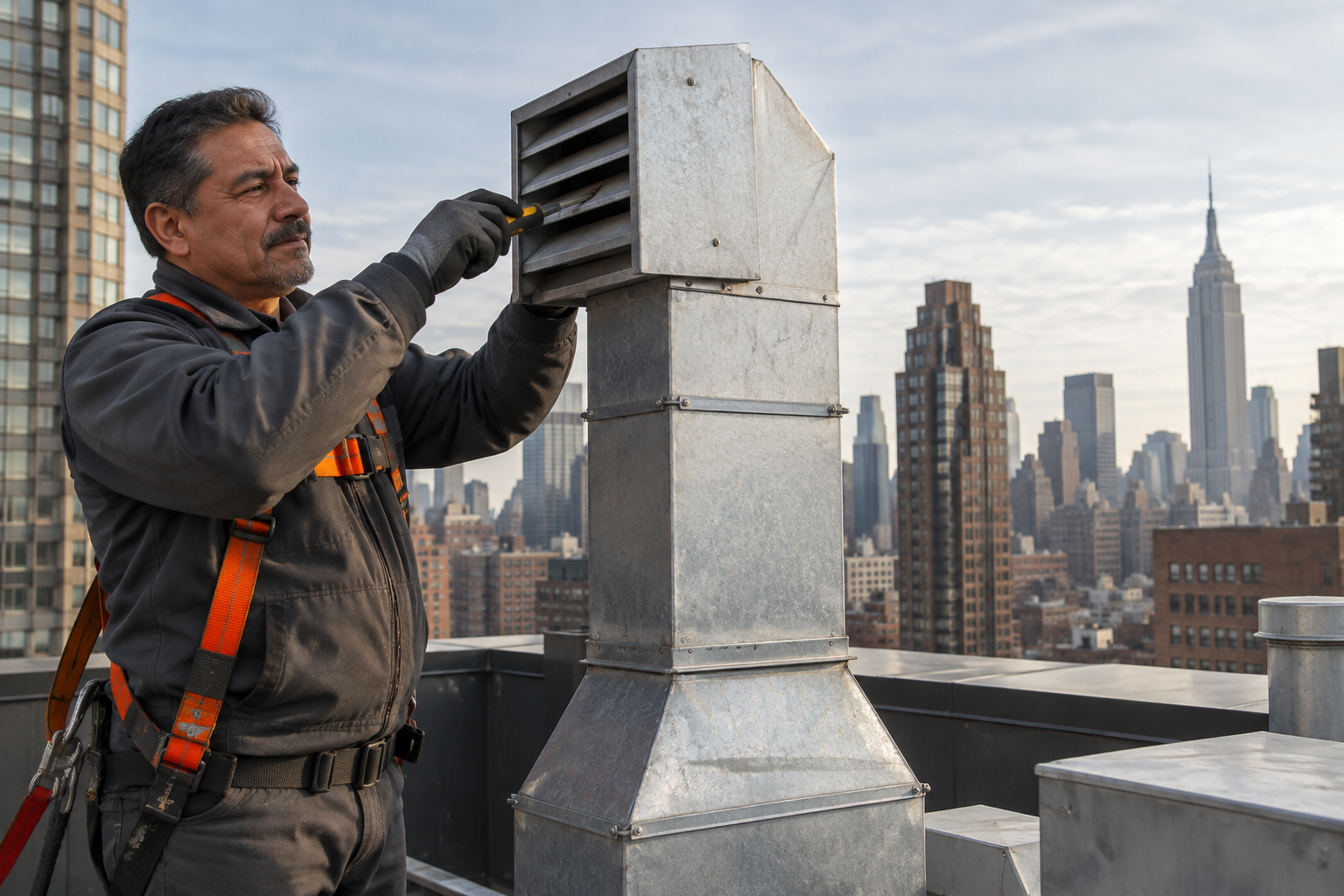
Because the distance to the roof often exceeds the blowing capacity of a standard residential dryer, high-rises utilize lint-trap booster fans. These fans are designed to kick on when they sense airflow, helping to push moist air up the height of the building. However, these fans are also magnets for lint.
Dryer vent problem? Talk to a technician today.
If a booster fan fails or becomes encased in debris, it becomes a literal wall inside the duct. For managers in Manhattan, where space is at a premium and ducts are often tucked behind finished soffits, accessing these fans for cleaning is a critical logistical hurdle. Regular inspection ensures these mechanical components assist airflow rather than obstructing it.
Navigating Complex Logistics in NYC Towers
Servicing a high-rise is vastly different from a standard residential call. It requires coordinated access to multiple units and the rooftop simultaneously. In large-scale developments across Brooklyn, technicians must manage stack-cleaning, where the riser is cleared from the top down while ensuring that dislodged lint does not blow back into individual apartments through the transition hoses.
Property managers must also navigate the legalities of unit access. Understanding dryer venting in condos and co-ops is essential for determining whether the building or the individual shareholder is responsible for the transition duct behind the machine. A cohesive maintenance plan usually involves cleaning both the individual unit lines and the common riser to ensure the entire system operates at peak efficiency.
Maintenance Checklist for Building Managers
To maintain safety and efficiency in a vertical environment, consider the following technical checkpoints:
- Rooftop Termination Inspection: Ensure the bird screens at the roof level are not clogged with lint, which can happen quickly in buildings with high occupancy.
- Booster Fan Testing: Verify that fans are triggering correctly and are not vibrating excessively, which indicates an imbalance caused by lint buildup.
- Unit-Level Airflow Tests: Conduct periodic checks at the wall cap behind the dryer to ensure the exit velocity meets the appliance manufacturer’s requirements.
- Transition Duct Replacement: Replace any plastic or foil flexible ducting with semi-rigid metal to improve fire resistance and airflow.
- Documentation: Maintain a log of when each riser was last professionally cleaned to satisfy insurance requirements and local safety codes.
DVC Experts Inc. brings 25+ years of experience to the complex venting needs of NYC high-rises. We provide comprehensive cleaning and inspection for managed portfolios across Queens, Long Island, and the five boroughs. To schedule an assessment of your building's vertical risers or to discuss a recurring maintenance contract, call 1 718-305-7888 or visit our contact page. Our office is located at 509 Dahill Rd, Brooklyn, NY 11218.
Dryer vent problem? Talk to a technician today.
Related articles
- Dryer Vent Cleaning for NYC Building Crews
- Establishing a Professional Laundromat Dryer Vent Maintenance Schedule
- Multi-Family Dryer Vent Maintenance for NYC Property Managers
Managing a building or laundromat? See our commercial dryer vent cleaning.