
How it works
When a Dryer Vent Booster Fan is Necessary for Long Duct Runs
September 19, 2026
You live in a Manhattan high-rise or a renovated Brooklyn brownstone where the laundry closet is tucked deep into the floor plan. Every time you run a load of towels, you notice the laundry room becomes a sauna, and the dryer takes three full cycles to finish. You have cleaned the lint trap, yet the machine struggles to push hot, moist air through thirty feet of ductwork to the outside wall. This is a common bottleneck in dense urban housing where structural constraints dictate long, winding exhaust paths.
How do you determine if your ductwork exceeds the manufacturer’s length limits? What role does a dryer booster fan play in maintaining velocity? Can mechanical assistance prevent the premature failure of your appliance?
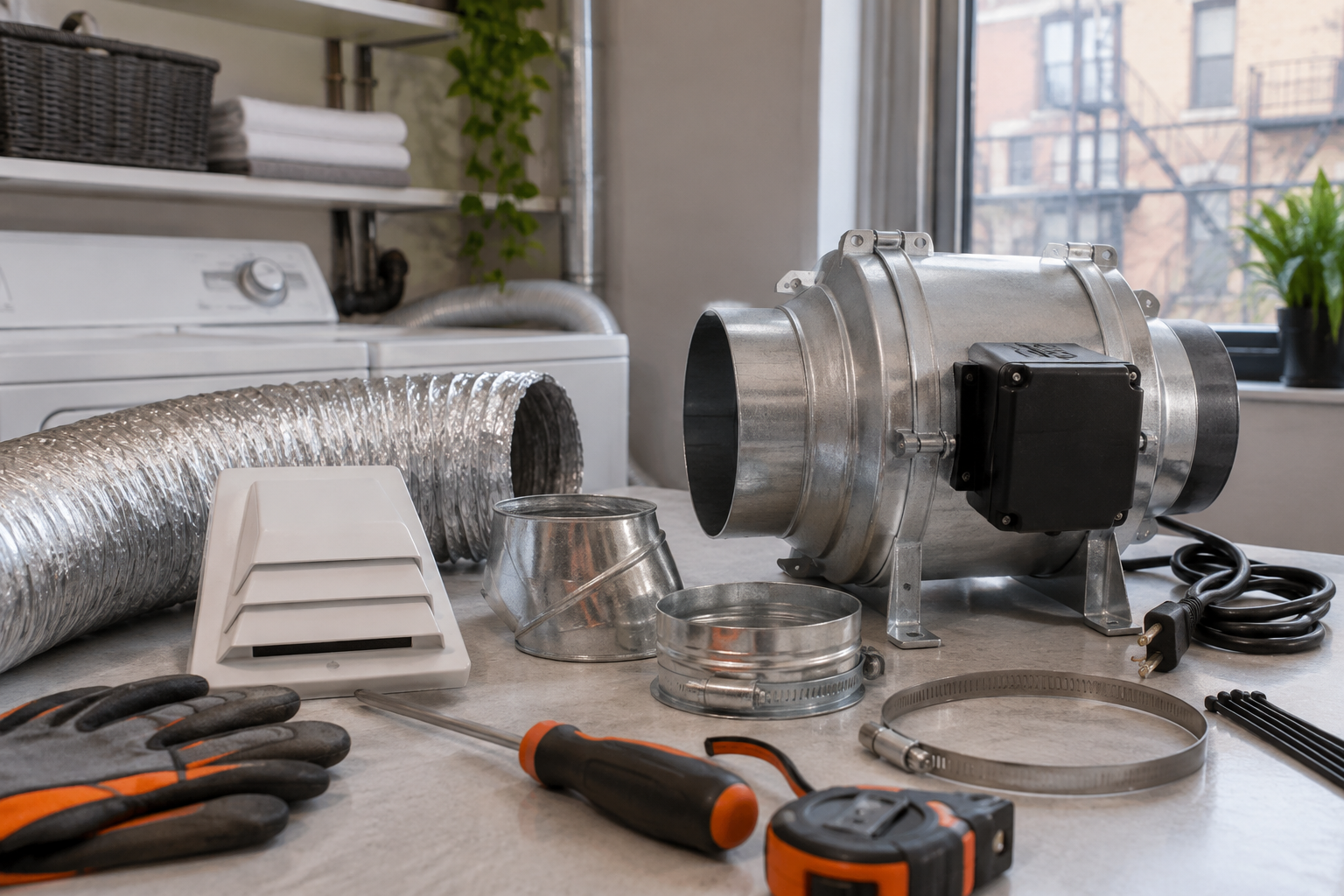
A dryer booster fan is a secondary motor installed within the exhaust line to maintain consistent airflow when the dryer’s internal blower cannot overcome the resistance of a long duct run.
The Physics of a Long Dryer Duct
Every dryer comes with a built-in blower motor designed to push air a specific distance. In a typical NYC apartment or home, this distance is often compromised by turns, elbows, and vertical climbs. According to the U.S. Fire Administration, lint buildup is a leading cause of dryer fires, and this buildup happens significantly faster when airflow velocity drops.
When a duct is too long, the air slows down before it reaches the exit. As the air cools, moisture condenses and lint becomes heavy, sticking to the interior walls of the pipe. If you manage a large residential portfolio or live in a commercial space with stacked units, you may find that the internal blower is simply not powerful enough to clear the line. In these instances, a booster fan acts as a relay, picking up the air mid-stream and pulling it toward the exterior vent.
Signs Your System Needs Mechanical Assistance
The most obvious sign of poor airflow is extended drying times. However, in Manhattan apartments where space is at a premium, ductwork is often hidden behind soffits or under flooring, making it hard to see a physical blockage. If the top of your dryer is hot to the touch or if you see moisture dripping from duct joints, the backpressure is likely too high.
Dryer vent problem? Talk to a technician today.
Professional diagnostic tools can measure the "inches of water column" (pressure) to determine if the duct exceeds the appliance's capabilities. Often, homeowners confuse the need for a fan with the need for a basic cleaning. While a fan helps, it cannot push air through a solid wall of lint. Understanding what determines dryer vent cleaning cost in NYC can help you budget for the necessary maintenance before deciding if an expensive hardware upgrade like a booster fan is the right solution.
The Function and Installation of a Dryer Booster Fan
Unlike a standard exhaust fan, a dryer booster fan is specifically engineered to handle lint-laden air. These units are usually pressure-activated; when the dryer turns on, the fan senses the change in air pressure and engages automatically. For Brooklyn homeowners with laundry located in the basement, these fans are often installed in the ceiling joists where the duct makes its final run toward the exterior wall.
Proper placement is critical. A fan installed too close to the dryer can create a vacuum that pulls lint into the fan blades, causing them to balance poorly or fail. Conversely, a fan installed too far away may not be able to overcome the initial resistance. The goal is to ensure the air maintains a velocity of at least 1,200 feet per minute to keep lint in suspension until it exits the building.
Maintenance Requirements for Boosted Systems
Adding a booster fan adds a mechanical failure point to your ventilation system. While they are highly effective for residential properties with complex layouts, they require their own maintenance schedule. If the fan fails, it actually becomes a major obstruction, blocking more air than it would have helped if it were functioning.
In Long Island homes where vents might run through long crawlspaces or attics, a failed booster fan often goes unnoticed until the dryer’s thermal fuse blows. Regular inspections should verify that the pressure switch is engaging and that the fan blades are not caked with debris.
Decision Checklist for Homeowners
Before installing a booster fan, evaluate your system against these criteria:
- Measure the total length: Most manufacturers recommend a maximum of 35 feet, minus 5 feet for every 90-degree elbow.
- Verify the exit point: Ensure the exterior flap is not stuck or blocked by a screen.
- Perform a pressure test: A technician can tell you if the CFM (cubic feet per minute) at the exit meets the dryer's requirements.
- Clean the line first: A fan should never be installed on a dirty duct.
DVC Experts Inc. brings 25+ years of experience to every job, ensuring your ventilation system is safe and efficient. Whether you are in a high-rise or a single-family home, we provide straightforward solutions for complex airflow problems. If your dryer is struggling to keep up, contact us at 1 718-305-7888 or visit our /contact page to schedule an inspection at our 509 Dahill Rd, Brooklyn, NY 11218 location.
Dryer vent problem? Talk to a technician today.
Related articles
- Understanding Dryer Vent Length Limits and Duct Elbows in NYC Buildings
- Why Your Dryer is Overheating and Shutting Off Mid-Cycle
- Foil Versus Rigid Metal Duct: Which is Safer for NYC Homes?
Need help at home? See our residential dryer vent cleaning.