
How it works
Understanding Dryer Vent Length Limits and Duct Elbows in NYC Buildings
October 3, 2026
In a compact Manhattan apartment or a sprawling Brooklyn brownstone, the laundry setup is often dictated by available space rather than optimal engineering. You might notice your dryer taking two or three cycles to finish a single load of towels, or perhaps the laundry closet feels excessively humid. Often, the culprit is not the appliance itself, but a vent run that exceeds physical limits or contains too many sharp turns.
Why does the distance between your dryer and the exterior wall matter so much for fire safety? How do elbows and bends secretly add hidden distance to your ductwork? What can be done when a building’s layout makes a short, straight vent run impossible?
Proper dryer performance depends on maintaining specific airflow velocity, which is directly compromised by excessive duct length and the friction caused by every turn in the line.
The Calculation of Equivalent Length
In the world of HVAC and fire safety, the physical measurement of a duct is only part of the story. The concept of "equivalent length" is used to account for the friction and turbulence created by bends in the pipe. A standard 90-degree elbow significantly restricts airflow, often equivalent to adding five to eight feet of straight pipe to the total run.
Building codes generally set a dryer vent length limit of 35 feet, but this number is reduced every time an elbow is installed. If your residential setup includes three 90-degree turns to navigate around a structural pillar or a bathroom, your actual allowable straight-line distance drops significantly. For many Manhattan high-rises, these complex routes are common, leading to premature lint buildup as the air loses the velocity needed to carry debris all the way to the exit.
Why Turns and Elbows Cause Clogs
Every time air hits a bend, it slows down. In a dryer vent, this slowed air allows heavy, wet lint to drop out of the airstream and collect in the corners of the elbow. Over time, these collections harden into thick blockages. Unlike a straight pipe, which might have a thin layer of dust, an elbow can become completely obstructed, forcing the dryer to overheat.
Dryer vent problem? Talk to a technician today.
In commercial environments like laundromats or gyms, where dryers run constantly, these accumulation points are the primary sites for potential fires. If your building uses dryer vent covers and screens, a restricted flow due to too many elbows makes it even harder for the air to push through the final exterior flap, often resulting in moisture backing up into the drum.
The Risks of Exceeding Length Limits
When a vent run is too long, the dryer’s internal blower fan cannot overcome the backpressure. The U.S. Fire Administration notes that failure to clean the dryer vent is a leading cause of home clothes dryer fires. This risk is compounded when the vent is so long that lint cannot physically reach the outdoors.
In older Brooklyn multi-family dwellings, we often see vents that have been rerouted through crawlspaces or joists over distances exceeding 50 feet. These long runs stay damp longer, which can lead to mold growth within the ductwork and accelerated corrosion of the metal. Furthermore, the longer the pipe, the more surface area there is for lint to attach to, making professional cleaning a critical maintenance task rather than an optional one.
Solutions for Complex NYC Layouts
If your laundry room is located in the center of a building far from an exterior wall, you have three primary options to ensure safety and efficiency:
- Booster Fans: These are secondary fans installed along the duct run that trigger when the dryer starts. They help maintain airflow velocity over long distances. However, they require their own maintenance and must be kept clean to function.
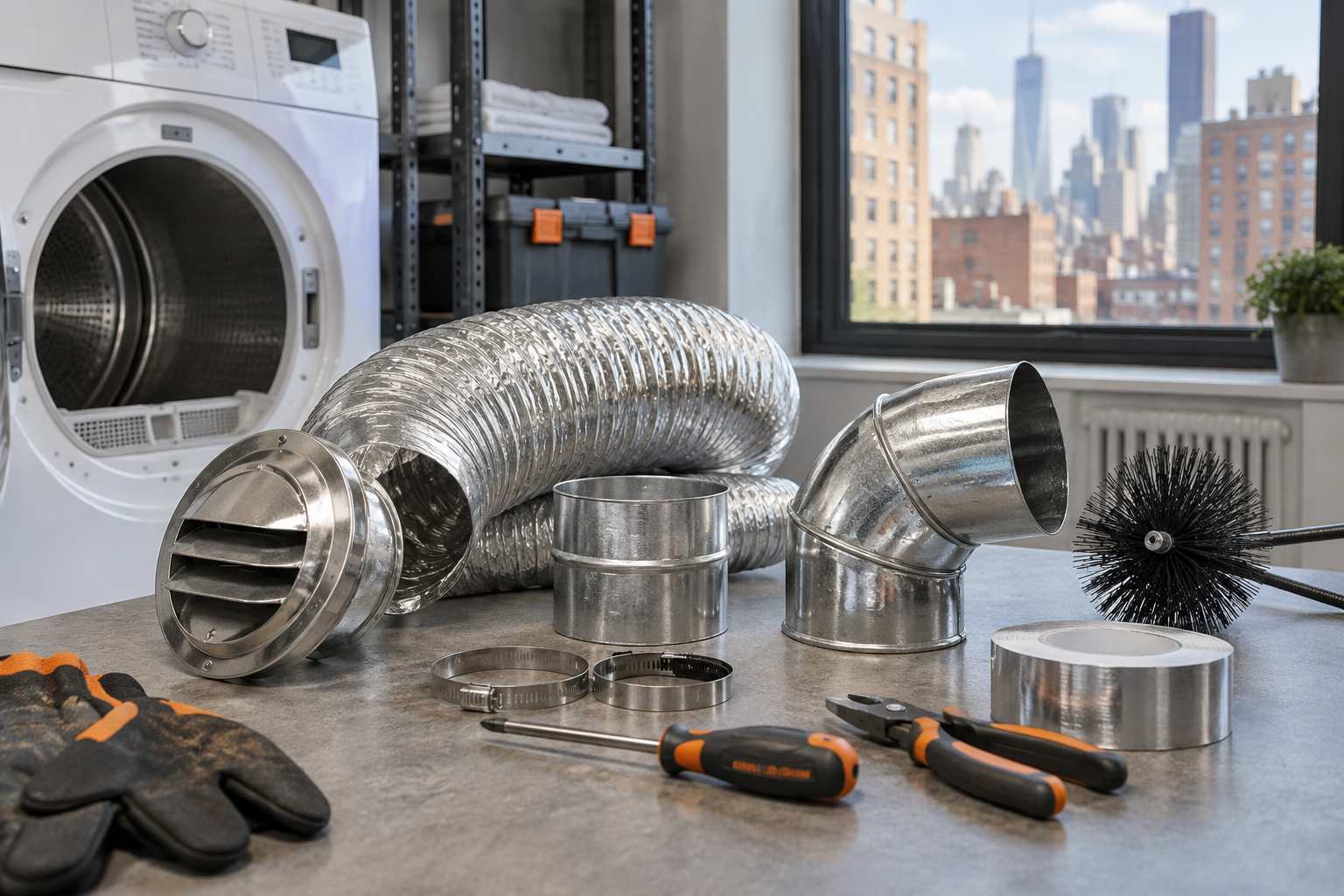
- Rigid Metal Ductwork: Replacing flexible foil or plastic venting with smooth-walled rigid metal reduces friction. Smooth interior surfaces allow air to move more freely than the ribbed interior of a flex-pipe.
- Rerouting: In some cases, especially during renovations in Queens, the best solution is to create a new, shorter path to the outside, even if it requires a new core drill through an exterior wall.
Duct Design Checklist
Use this framework to evaluate your current dryer installation:
- Measure the straight runs: Calculate the total feet of pipe from the back of the dryer to the wall cap.
- Count the elbows: Factor in at least 5 feet for every 90-degree turn and 2.5 feet for 45-degree turns.
- Check for transitions: Ensure the transition duct (the piece connecting the dryer to the wall) is not crushed or kinked, as this acts like an extreme elbow.
- Verify the material: Confirm the entire run is made of rigid or semi-rigid metal, not flammable plastic or thin foil.
- Audit performance: If a load takes more than 45 minutes to dry, your equivalent length is likely too high or the line is already restricted.
DVC Experts Inc. has 25+ years of experience navigating the complex venting requirements of New York City properties. Whether you are managing a portfolio of apartments or maintaining a single-family home, we provide the technical expertise to ensure your venting meets safety standards. For an inspection or to schedule a professional cleaning, contact DVC Experts Inc. at 1 718-305-7888.
Dryer vent problem? Talk to a technician today.
Related articles
- When a Dryer Vent Booster Fan is Necessary for Long Duct Runs
- Roof Dryer Vents in NYC Buildings: What to Know
- Why Your Dryer is Overheating and Shutting Off Mid-Cycle
Managing a building or laundromat? See our commercial dryer vent cleaning.