
Property management
Landlord Responsibilities for Dryer Vents in New York
September 22, 2026
A tenant in a Brooklyn brownstone notices it takes three cycles to dry a load of towels. The landlord assumes the tenant just needs to clean the lint trap, while the tenant believes the building’s internal ductwork is clogged. In the high-density environment of New York City, this lack of clarity often leads to neglected maintenance, increased utility costs, and serious fire hazards. When a vent passes through common walls or several floors of a multi-family building, determining who is responsible for the cleaning becomes a matter of safety and legal obligation.
Who is legally required to maintain the vent line in a New York rental? Does the responsibility change between a single-family home in Queens and a high-rise in Manhattan? How often must these systems be professionally serviced to meet local safety standards?
In New York, while tenants are responsible for day-to-day lint trap cleaning, landlords are generally responsible for the structural integrity and clear passage of the entire dryer exhaust system to ensure the property remains in a habitable and safe condition.
Defining Maintenance Boundaries in NYC Rentals
Under the New York State Warranty of Habitability, landlords must keep their properties in a condition that is fit for human habitation and free from conditions that are dangerous to life, health, or safety. Because a clogged dryer vent is a documented fire hazard, the maintenance of the hidden ductwork typically falls under the landlord’s duty to maintain the building's systems.
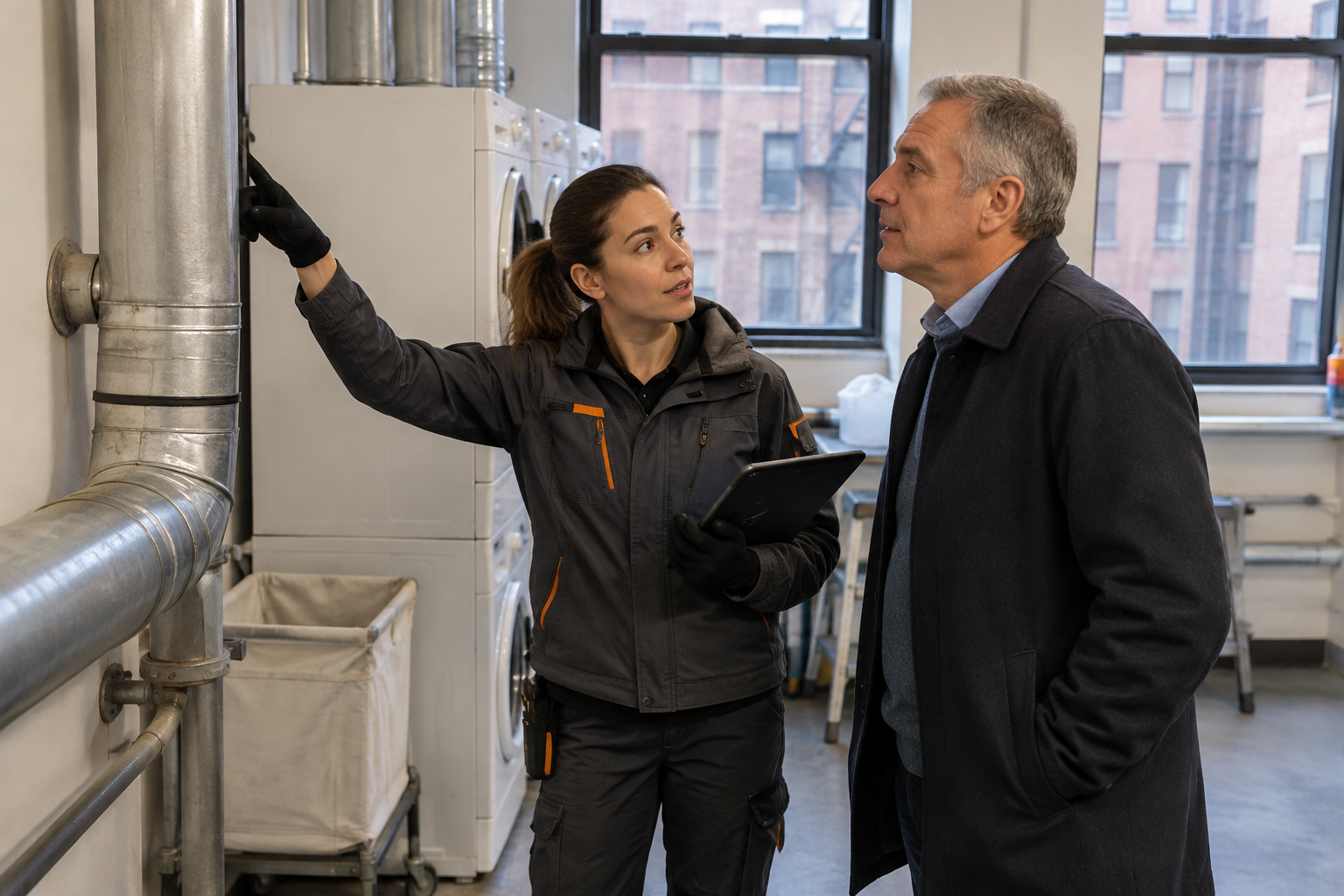
For most residential properties, the division of labor is clear: the tenant manages the removable filter inside the machine, and the landlord manages everything from the back of the dryer to the exterior wall or roof cap. In a Manhattan apartment complex, the ductwork often runs through interstitial spaces that a tenant cannot access. In these scenarios, the landlord must ensure that the transition duct and the main vertical or horizontal runs remain unobstructed. If a tenant reports a slow-drying machine, ignoring the request can lead to premature appliance failure or, worse, a fire that affects multiple units.
The Impact of Clogged Vents on Managed Portfolios
For those overseeing commercial accounts or large residential portfolios, the risk of negligence is magnified. A single blockage in a shared laundry room or a stacked unit in a Brooklyn co-op can impact the air pressure and safety of the entire line. According to the U.S. Fire Administration, failure to clean dryer vents is the leading cause of clothes dryer fires.
Dryer vent problem? Talk to a technician today.
Beyond fire safety, landlords must consider the structural risks associated with poor venting. When moist air cannot escape the building, it can lead to condensation inside wall cavities, resulting in mold growth and wood rot. This is particularly common in older buildings where vents may have been improperly routed during renovations. Landlords should also be aware of the complications caused by external factors; for instance, handling bird and rodent nests in NYC dryer vents is a frequent necessity in the spring months across the five boroughs, and removing these obstructions is strictly a management responsibility.
Lease Agreements and Local Compliance
While state law provides a baseline for safety, the specific language in a lease or co-op proprietary lease can further define roles. In many Queens rental agreements, landlords specify that tenants must report any dryer malfunctions immediately. However, a landlord cannot contract away their basic safety obligations. If a fire occurs due to a known blockage that the landlord failed to clear, the liability remains with the property owner.
Regular inspections are the most effective way to avoid disputes. DVC Experts Inc. suggests that property managers in the Long Island and NYC area implement an annual or semi-annual maintenance schedule. This proactive approach ensures that the ductwork is not only clear of lint but also free of mechanical failures, such as disconnected joints or crushed transition hoses, which are common in tight NYC laundry closets.
Decision Framework for Landlords and Tenants
If you are unsure where the responsibility lies for a specific maintenance issue, use the following checklist to determine the next steps:
- Check the Lint Trap: If the trap is clear but the dryer is hot to the touch, the problem is likely in the wall duct (Landlord responsibility).
- Inspect the Transition Hose: If the flexible hose behind the dryer is kinked or full of lint, it should be replaced. In most managed buildings, the landlord handles this to ensure fire-rated materials are used.
- Verify Exterior Airflow: Check the vent flap outside. If no air is coming out while the dryer is running, there is a major blockage (Landlord responsibility).
- Review the Lease: Look for specific clauses regarding "appliance maintenance" versus "structural maintenance."
- Document Communication: Tenants should provide written notice of drying issues to establish a timeline of the request.
With over 25 years of experience, DVC Experts Inc. provides professional cleaning and inspection services for both residential and commercial properties throughout the New York City area. Maintaining clear vents protects your investment and ensures the safety of your tenants. To schedule a professional inspection or cleaning for your property, contact DVC Experts Inc. at 1 718-305-7888 or visit our contact page.
Dryer vent problem? Talk to a technician today.
Related articles
- Dryer Venting in Condos and Co-ops: Determining Responsibility
- Warning Signs of a Clogged Dryer Vent in NYC Properties
- Multi-Family Dryer Vent Maintenance for NYC Property Managers
Managing a building or laundromat? See our commercial dryer vent cleaning.