
Property management
Dryer Venting in Condos and Co-ops: Determining Responsibility
September 21, 2026
You are finishing a load of laundry in your Brooklyn condo when you notice a damp, hot smell lingering in the hallway. You check your dryer, but the cycle finished an hour ago. Later that evening, a neighbor two floors down mentions their laundry is taking three cycles to dry. In a multi-family building, these symptoms rarely exist in isolation. Because dryer exhaust systems often travel through common walls or connect to shared risers, a blockage in one unit can affect the safety and efficiency of several others.
Who is responsible for scheduling the cleaning of these hidden ducts? Does the burden fall on the individual unit owner or the building’s board of directors? How do proprietary leases and bylaws define where a resident’s property ends and the building’s infrastructure begins?
Understanding the division of maintenance responsibility in NYC multi-family buildings is the first step toward preventing lint-related fires and moisture damage.
The Line Between Unit and Common Element
In most New York City condos and co-ops, the governing documents—the Declaration and Bylaws for condos or the Proprietary Lease for co-ops—dictate maintenance duties. Generally, the "unit" includes everything from the finished surface of the walls inward. This usually means the flexible transition duct connecting the back of the dryer to the wall is the resident's responsibility. However, once the ductwork enters the wall or floor slab, it is often classified as a "common element" or "limited common element."
For residents in Manhattan, where high-rise configurations are standard, dryer vents may travel dozens of feet through structural columns before reaching an exterior wall. In these scenarios, individual owners lack the access or equipment to clean the full length of the run. Boards often assume responsibility for the main vertical stacks, while requiring owners to maintain the individual lateral lines that feed into them.
Why Managed Cleaning is the Standard
Many boards in Brooklyn and beyond have shifted toward building-wide maintenance contracts rather than leaving it to individual choice. There are three practical reasons for this approach:
Dryer vent problem? Talk to a technician today.
- Uniform Safety: According to the U.S. Fire Administration, failure to clean dryer vents is the leading cause of clothes dryer fires. A fire in one unit endangers the entire building. By hiring a single contractor for residential service building-wide, the board ensures no unit is overlooked.
- Shared Infrastructure: Some buildings utilize a shared duct system where multiple dryers vent into a single larger riser. If one tenant ignores a blockage, it can create backpressure that forces carbon monoxide or moisture into other apartments.
- Complex Mechanics: Large buildings often require specialized hardware. For example, knowing when a dryer vent booster fan is necessary for long duct runs is a technical determination that a general handyman or resident may not be equipped to make.
Co-op Laundry Rules and Compliance
Co-op boards have broad authority to set house rules regarding appliance usage. Because the corporation technically owns the entire building, the board can mandate annual or biennial inspections. If a resident refuses access for a dryer vent cleaning, they may be in violation of their proprietary lease. This is particularly common in Queens garden apartments where vents may terminate on a roof that is inaccessible to the tenant.
When the board takes responsibility, the cost is typically rolled into the common charges or maintenance fees. This is often more cost-effective than individual owners hiring separate companies. For commercial spaces within these buildings, such as ground-floor laundromats, the responsibility almost always falls on the commercial tenant to provide proof of regular cleaning to the board to maintain insurance compliance.
Maintenance Checklist for Boards and Owners
To ensure clarity and safety, both parties should follow this framework:
- Review the Offering Plan: Identify if the ductwork is listed as a common element.
- Establish an Interval: The U.S. Fire Administration recommends cleaning dryer vents at least once a year; buildings with long, winding runs may require more frequent attention.
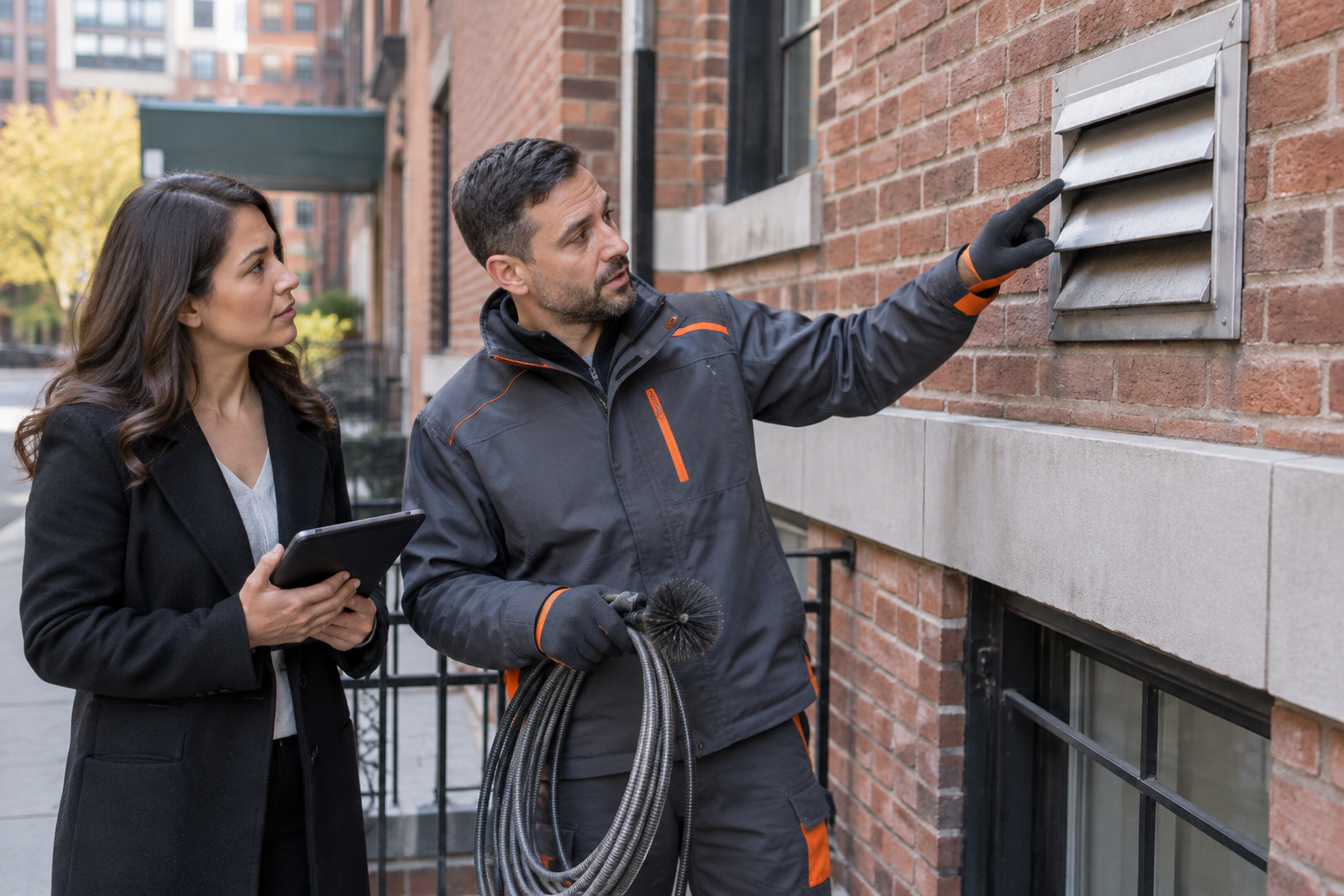
- Inspect Exterior Terminations: Boards should ensure that wall caps and roof vents are not obstructed by bird nests or broken louvers.
- Enforce Transition Duct Standards: Owners should ensure they are using semi-rigid metal foil rather than flammable plastic or thin foil connectors.
- Document Everything: Keep records of professional cleanings to satisfy insurance underwriters and city inspectors.
DVC Experts Inc. has over 25 years of experience navigating the unique architectural challenges of NYC multi-family housing. We provide thorough inspections and cleaning for residential and commercial clients to ensure your building remains compliant and safe.
If your board needs to schedule a building-wide inspection or if you are a unit owner concerned about airflow, contact DVC Experts Inc. at 1 718-305-7888 or visit our contact page to request a consultation. We serve all five boroughs and Long Island with professional, reliable service.
Dryer vent problem? Talk to a technician today.
Related articles
- Landlord Responsibilities for Dryer Vents in New York
- Warning Signs of a Clogged Dryer Vent in NYC Properties
- Why Your Dryer Takes Two Cycles to Dry One Load
Managing a building or laundromat? See our commercial dryer vent cleaning.